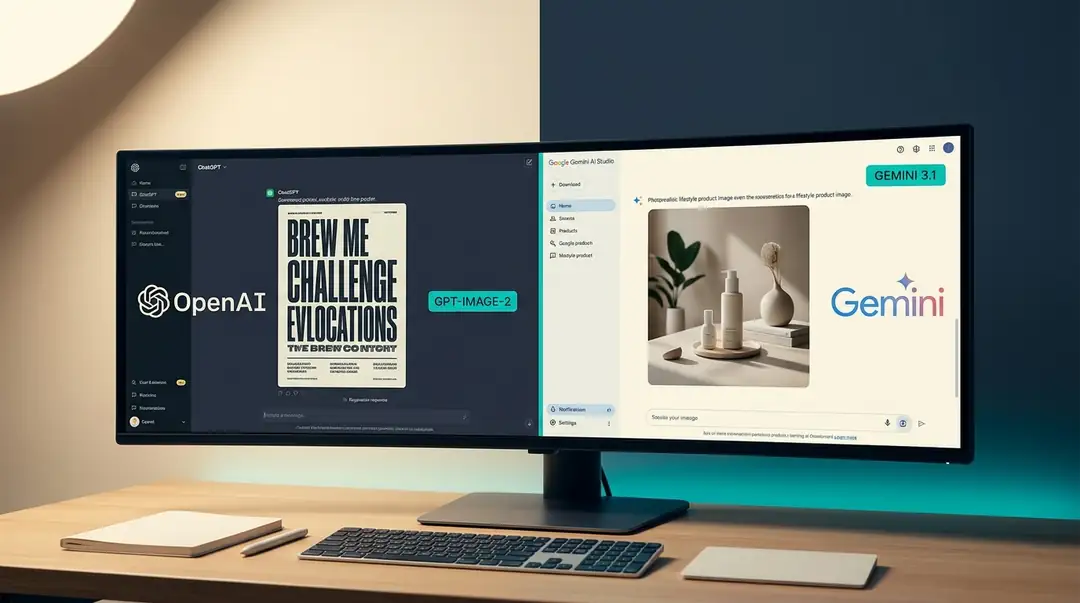
OpenAI's gpt-image-2 landed on April 21, 2026, claimed the top spot on the Image Arena leaderboard within 12 hours, and leads the field by a +242 Elo margin — the largest gap ever recorded on that leaderboard. Google's Gemini 3.1 Flash Image counters with sub-2-second generation, a $0.039 per-image price tag, and photorealism scores that edge ahead at default quality. Both are genuinely capable. The question is which one fits your workflow.
Why the image generation race shifted in 2026
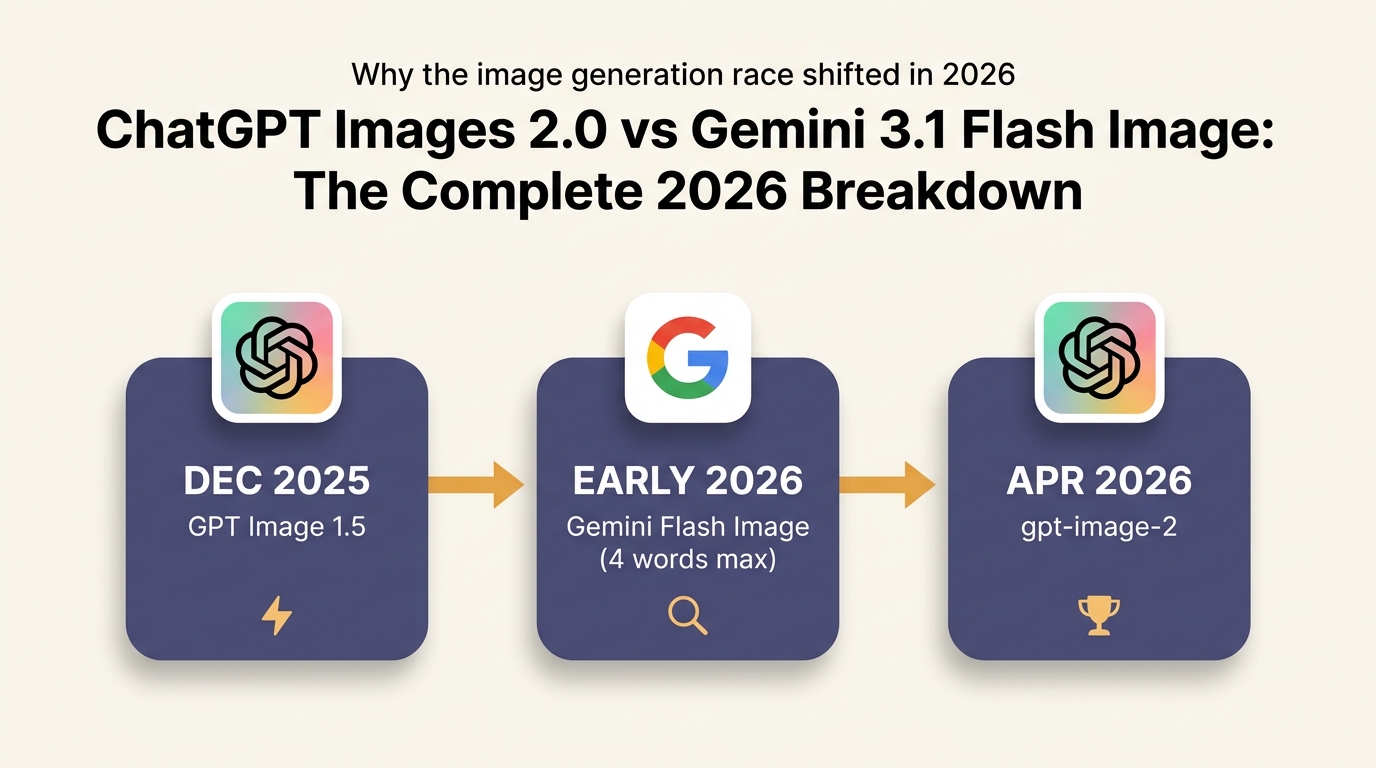
For most of 2025, Midjourney owned the aesthetic end of AI image generation and Stable Diffusion held the open-source lane. Neither OpenAI nor Google had a product that competed on raw output quality for professional workflows. That changed when OpenAI shipped GPT Image 1.5 in December 2025 — 4× faster inference, precise instruction-following, and the best text rendering of any model at launch. Google countered in early 2026 with Gemini 2.5 Flash Image (also surfaced under the API model ID google/gemini-3.1-flash-image-preview), folding real-time Google Search into the generation loop — a capability no other image model at this price point offered. By April 2026, gpt-image-2 raised the bar further with a native Thinking mode that plans layouts mathematically before touching pixels. The two models now sit at Image Arena Elo scores of 1,512 and 1,271 respectively, and the gap between them is narrow enough to shape production decisions.
Core architecture and generation modes
On paper, both generate images from text prompts and edit existing images via natural language. The implementations diverge meaningfully in how they handle context and complexity.
gpt-image-2 runs in two modes. Instant mode works like a fast conventional diffusion pipeline, is available on the free ChatGPT tier, and delivers results in seconds. Thinking mode wraps the generation in a full reasoning loop — the model plans compositions, counts elements, balances whitespace, and verifies output before finalizing. Thinking mode is capped to Plus ($20/mo), Pro ($100/mo), and enterprise tiers, and can take up to two minutes per generation. That latency is worth it for complex multi-element layouts and typography-heavy assets. It is not suited for volume work.
Gemini 3.1 Flash Image embeds generation inside the broader Gemini multimodal architecture. When you prompt it, it can call Google Search mid-generation to pull live factual references — useful when your prompt includes a real building, a recent product design, or a dated object like a 2026 vehicle. The result is fewer hallucinated details in real-world scenes. It also natively fuses multiple input images into a single output, a workflow gpt-image-2 requires additional prompt engineering to approximate.
Text rendering and typography
This is where gpt-image-2 pulls the clearest lead. OpenAI reports text rendering accuracy at approximately 99% for Latin script and around 95% across non-Latin scripts including Japanese, Korean, Chinese, Hindi, and Bengali. In practice, that means posters with readable copy, UI mockups with actual button labels, infographics with legible data annotations, and multilingual ad creatives that do not require manual cleanup post-generation. Previous models, including GPT Image 1.5, topped out at 90–95% on Latin text. gpt-image-2 has meaningfully raised that ceiling.
Gemini 3.1 Flash Image's own documentation acknowledges "long-form text rendering needs improvement." Short labels — four words or fewer — perform acceptably. Anything denser degrades: multi-line chart legends, UI walkthrough screenshots with paragraph copy, recipe cards with ingredient lists. If your primary use case puts words inside images, the routing decision is straightforward: gpt-image-2 is the better tool and there is no close second at the moment.
Photorealism, scene fidelity, and character consistency
Flip the comparison for photorealism. Independent benchmarks put Gemini 3.1 Flash Image's Fréchet Inception Distance score below gpt-image-2 on standard photorealistic prompts. Scenes with natural light, skin tones, fabric texture, and complex backgrounds look marginally more credible out of Gemini at its default quality tier. gpt-image-2 Instant mode delivers vivid, technically sharp results but carries a slightly processed quality that experienced reviewers notice.
Enable gpt-image-2 Thinking mode and the photorealism gap narrows because the model spends real compute on scene composition, depth layering, and lighting logic. Even so, "marginally" remains the accurate description — neither model completely dominates on this dimension the way gpt-image-2 dominates text rendering.
Character consistency is a meaningful Gemini advantage. Building a visual novel, product lookbook, or avatar set where the same subject needs to look recognizably consistent across 20+ frames? Gemini's character-consistency pipeline holds up better over longer sequences. gpt-image-2 can generate up to eight consistent images per prompt — adequate for short sets, insufficient for extended narrative or brand asset production. Teams building AI-generated character systems should weight this factor heavily.
Image editing and multi-image input
Both models accept existing images as input. Gemini 3.1 Flash Image handles editing operations through natural language without masking tools or selection layers: blur the background, remove a person from a group photo, recolor a product, alter a pose, or add color to a black-and-white photo. These work at moderate complexity with consistent output quality. The multi-image fusion capability — blending two or more reference photos into a single generated result — is particularly useful for product mockups that combine a real background photo with a new product render.
gpt-image-2 editing is strong within a generation session. Its Thinking mode continuity editing is the standout: generate the base image, describe a change, and the reasoning loop maintains layout consistency between versions. For marketing teams iterating on a creative where the base composition stays fixed and only surface details change across market variants, gpt-image-2 is the more predictable pipeline. For standalone ad-hoc edits submitted cold via API, Gemini is generally faster and simpler.
Speed and API pricing
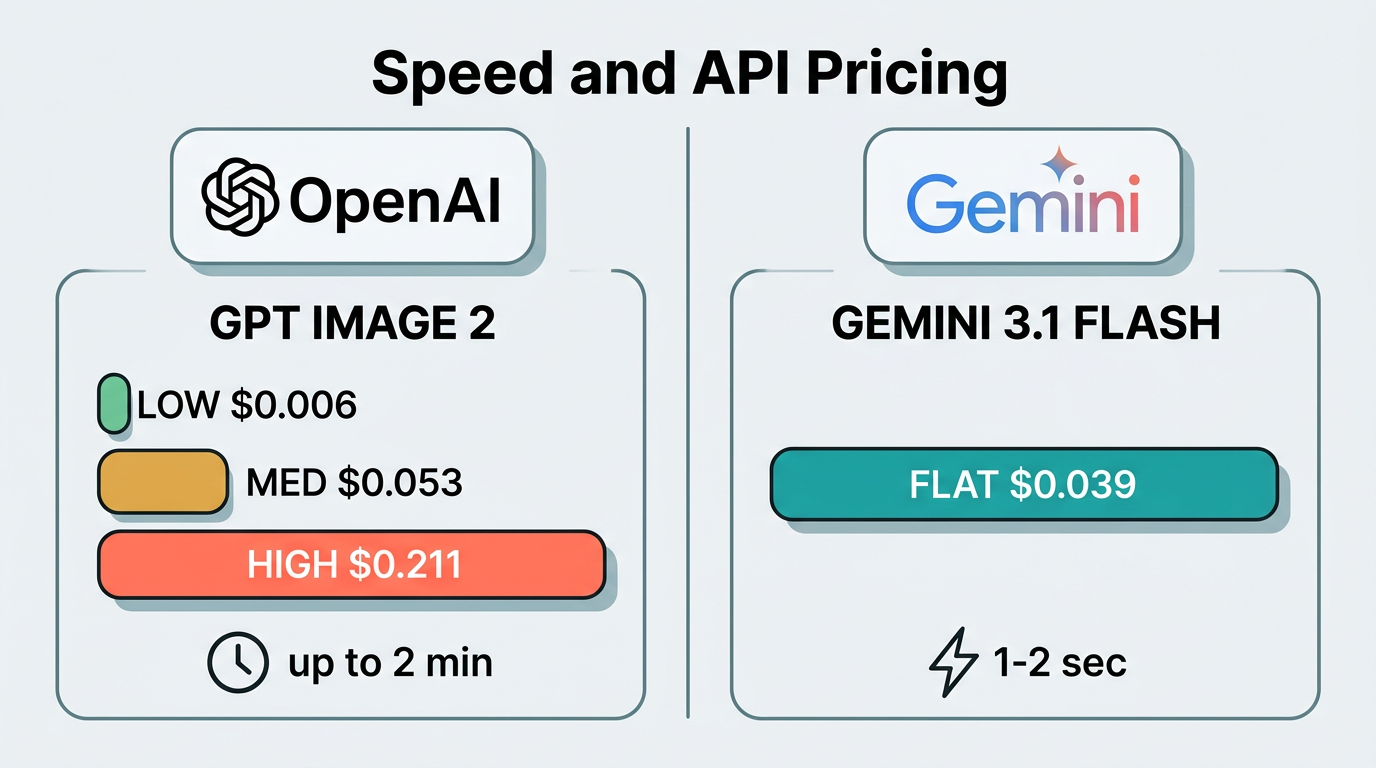
Gemini 3.1 Flash Image generates standard images in one to two seconds. Most moderately complex tasks complete in under ten seconds. At $0.039 per 1024×1024 image ($30 per million output tokens), it undercuts gpt-image-2 medium quality and substantially undercuts gpt-image-2 high quality.
gpt-image-2 API pricing for a 1024×1024 output runs $0.006 at low quality, $0.053 at medium, and $0.211 at high. A 50% batch discount applies to token costs. Thinking mode adds generation latency — up to two minutes — but no separate per-image charge; you pay only the token cost of the reasoning trace. At high volume (tens of thousands of images per month), Gemini's flat rate is usually cheaper unless everything routes to gpt-image-2 low quality.
- gpt-image-2 high quality — $0.211 per 1024×1024. Best layout precision and typography; Thinking mode latency up to 2 minutes.
- gpt-image-2 medium quality — $0.053 per image. Most product teams default here; strong balance of quality and cost.
- gpt-image-2 low quality — $0.006 per image. Fast drafts, thumbnail assets, and high-volume pipelines where speed beats fidelity.
- Gemini 3.1 Flash Image — $0.039 per image. Single flat tier, fastest generation, no quality ladder to manage.
On the consumer side, gpt-image-2 Instant mode is available on the free ChatGPT tier within usage limits. Thinking mode requires Plus ($20/mo) or higher. Gemini 3.1 Flash Image is available free for testing via Google AI Studio, and through OpenRouter for developers who want both models under one billing surface.
Who each model is built for
Use gpt-image-2 when your output needs to carry text. Marketing agencies building localized ad creatives, developers building infographic-as-a-service tools, and product teams generating pitch deck mockups should default here. The 2048×2048 native resolution, continuous aspect ratio range from 3:1 ultrawide to 1:3 vertical, web search integration on Plus and above, and the eight-image consistency pipeline together form a strong professional content toolchain. Multilingual typography at 95% accuracy across five non-Latin scripts is the decisive factor for global marketing workflows.
Use Gemini 3.1 Flash Image when speed and photorealism at low cost matter more than text accuracy. Product teams generating hundreds of lifestyle mockups per day, real estate platforms building consistent room-render templates, and applications requiring character-consistent avatars will get more value from Gemini's speed and pricing. The Google Search integration during generation is worth stating plainly: any prompt referencing a real-world entity — a current car model, a named building, a recent brand identity — produces measurably better factual accuracy because the model retrieves information rather than extrapolating from training data alone.
How to put it all together
Most teams running both models in production use a simple routing rule: typography-heavy or complex multi-element layout work goes to gpt-image-2 medium or high quality; photorealistic scene generation, product mockups, and character-consistent sequences at volume go to Gemini 3.1 Flash Image. A blended approach costs roughly $0.039–$0.053 per image on average — less than a stock photo library subscription at comparable volume. OpenRouter carries both models under a single API key and billing surface, which simplifies integration for teams that prefer not to manage two separate vendor accounts.
Closing thoughts
gpt-image-2 wins on text fidelity, layout reasoning, and benchmark position. Gemini 3.1 Flash Image wins on speed, photorealism at its price point, character consistency over long sequences, and real-world accuracy through live search. Neither has made the other obsolete — which is what a competitive market looks like. You can compare both tools alongside every other AI image generator in the AI Image Generation category on AIToolsBox.