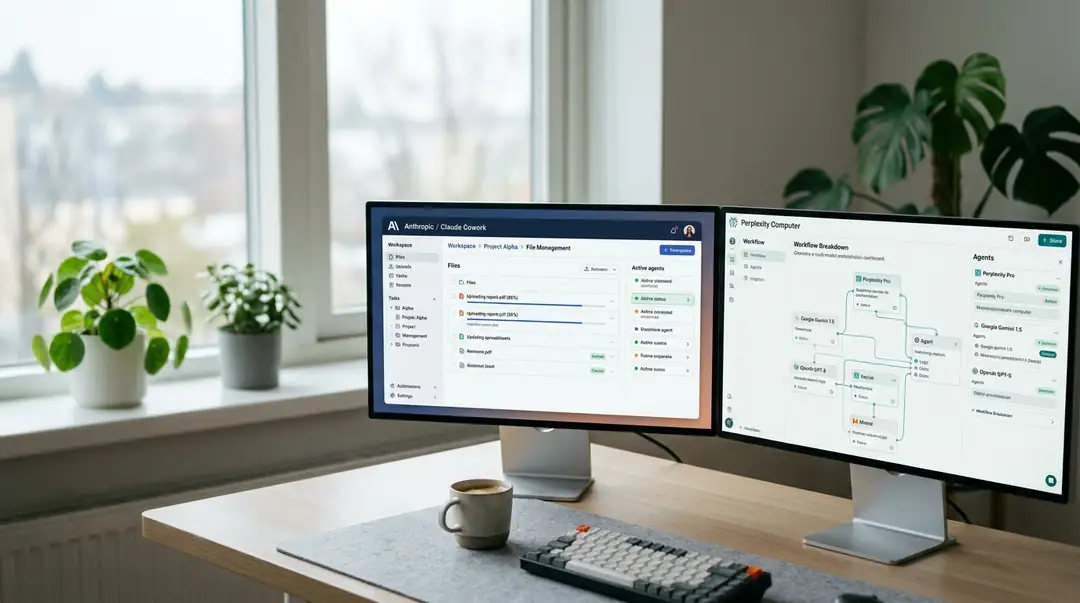
Two AI agents arrived within weeks of each other in early 2026, both claiming to do roughly the same thing: take a complex task off your plate and return a finished result. Claude Cowork launched in January. Perplexity Computer followed on February 25. They share a broad category, but their architectures, pricing, and ideal use cases differ significantly, and picking the wrong one is an expensive mistake.
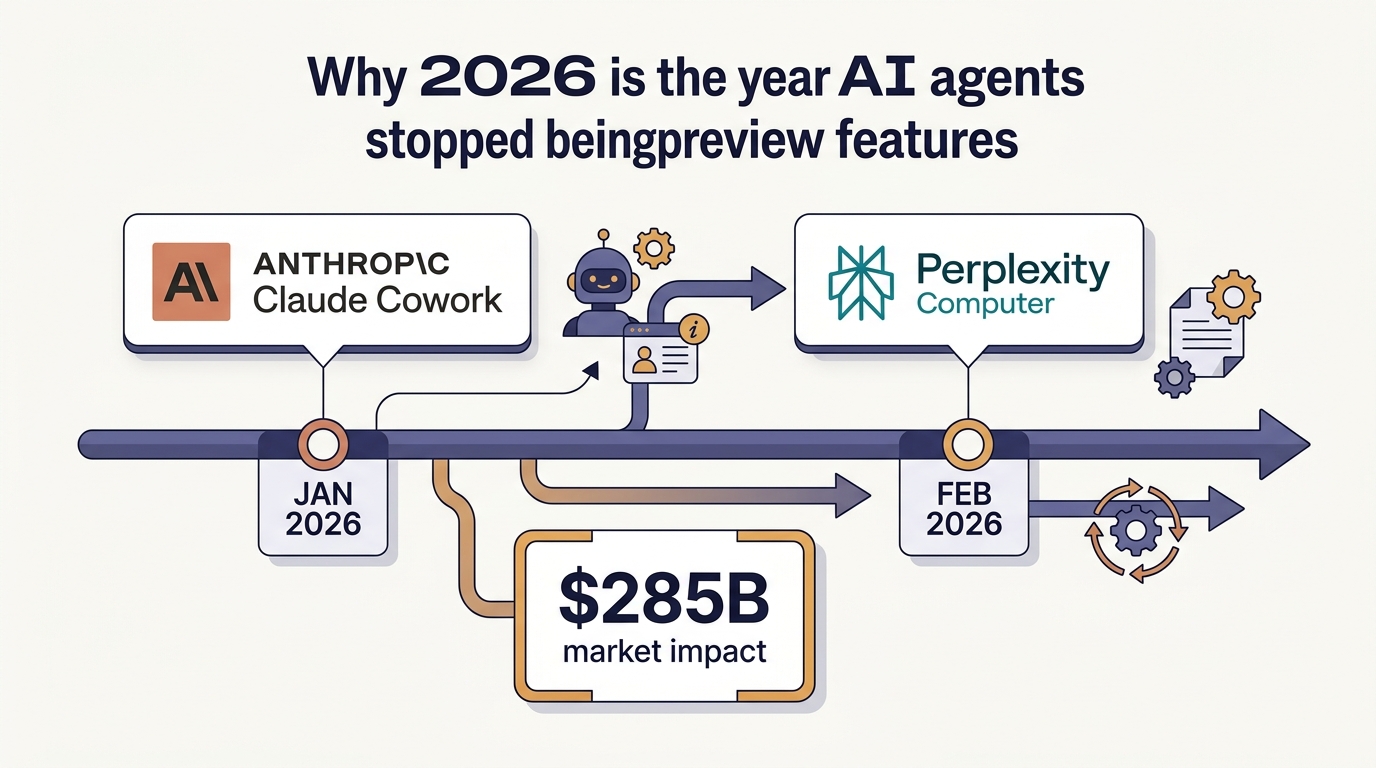
Why 2026 is the year AI agents stopped being preview features
Before these products, the agentic AI story lived mostly in developer tooling. Claude Code, which grew from a research preview to a billion-dollar product in under six months, proved that engineers would pay for an AI that could execute tasks rather than just suggest them. What Anthropic and Perplexity both bet on in early 2026 was that the same logic applied to everyone who works with documents, data, and applications every day. When Cowork shipped in January, the market responded immediately: enterprise software stocks shed a combined $285 billion in value as investors began reassessing companies whose products overlapped with what a desktop AI agent could now automate.
That reaction was not irrational. A February 2026 survey by CrewAI found that 100% of surveyed enterprises planned to expand their use of AI agents that year. Perplexity's own data showed that 92% of Fortune 500 companies already had employees using Perplexity on personal or work accounts. The infrastructure for widespread agent adoption was in place. The harder question was which approach suited a given worker, on a given budget, with a given type of work.
Claude Cowork — what it is and how it works
Cowork lives inside the Claude Desktop app and was designed for people who were never going to touch a terminal. Its origin story is direct: Anthropic noticed that non-developers were using Claude Code for tasks that had nothing to do with software, and in late 2025 the team built Cowork using Claude Code itself, reportedly in around two weeks. It shipped as a research preview in January 2026.
The core of what Cowork does is give Claude permission to read, edit, and create files in folders you specify on your own machine. That distinction matters: the difference between an AI that tells you how to organize a folder and one that actually organizes it is the gap that Cowork was built to close. You describe the goal in natural language. Cowork determines the steps, shows you the plan, and waits for your approval before taking any significant action. You can watch it work in real time or step away and come back to the result.
When a task requires going online, Cowork follows a priority order. If a connector exists for the service you need, such as Slack or Google Calendar, it uses that. If the job can be handled in Chrome, it uses the browser. Only when neither option applies does it take direct screen control, operating the desktop the way a person would by clicking, typing, and navigating through applications. Full computer use arrived on macOS on March 24, 2026, and Windows received full feature parity ten days later on April 3, built partly on technology from Anthropic's acquisition of Vercept AI.
The Dispatch feature, which shipped alongside computer use, lets you assign tasks from your phone and return to finished work on your desktop. You might leave for a meeting, send a task via Dispatch, and find a structured report waiting in your output folder when you get back. For recurring work, you define the cadence once. Cowork handles it from there, whether that is pulling metrics every Friday, running a weekly Slack digest, or checking emails each morning and surfacing what needs attention.
Pricing
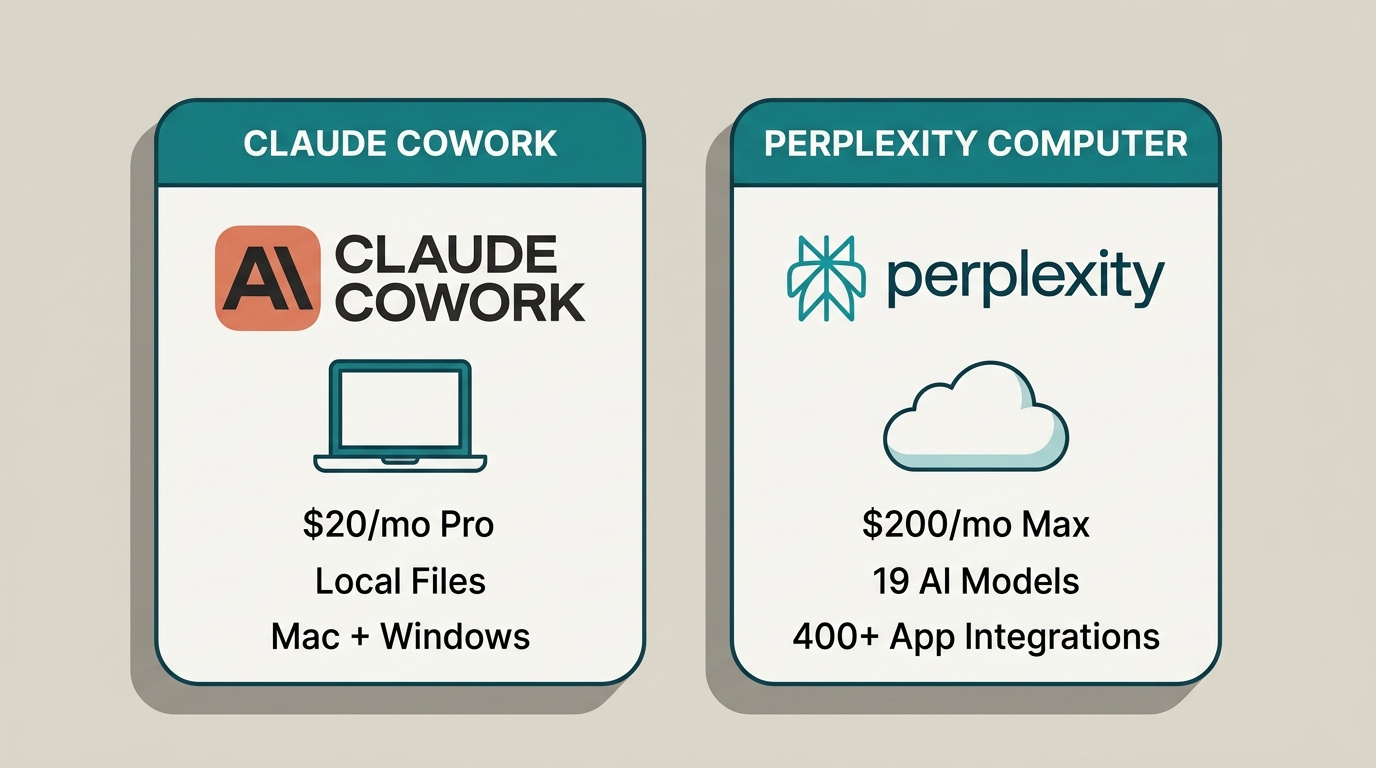
Cowork is included in all paid Claude plans through the Claude Desktop app. Claude Pro starts at $20 per month. Enterprise plans add admin controls, usage analytics, and private plugin marketplaces. Computer use is available to Pro and Max subscribers as a research preview.
What it does well
File organization, report assembly from local documents, recurring information tasks, and anything that requires working across your actual software stack rather than a cloud-only environment. Cowork integrates directly with the local file system, which most cloud-based automation tools cannot do by default.
Where it falls short
Cowork does not generate images or video. Its computer use feature is still in research preview, and Anthropic has been explicit about not recommending it alongside applications that handle sensitive data while the technology matures. A file-exfiltration vulnerability via prompt injection was demonstrated within two days of the January launch, underscoring the additional security considerations that come with a tool that has broad system access.
Perplexity Computer — what it is and how it works
Perplexity Computer launched February 25, 2026, and operates on a different premise. Rather than giving one model access to your local machine, it is an orchestration layer that routes each part of a task to whichever of 19 different AI models is best suited for that specific subtask. Claude Opus 4.6 handles the core reasoning. Gemini manages deep research. Veo 3.1 produces video. GPT-5.2 handles long-context recall. The model that generates your images is different from the model that writes your copy, which is different from the model that writes any code in your deliverable.
Perplexity's reasoning for this architecture comes from data they pulled from their own enterprise customers. In January 2025, over 90% of enterprise AI tasks on the Perplexity platform ran through just two models. By December 2025, no single model commanded more than 25% of usage across task types. Models had stopped becoming interchangeable and started specializing. A workflow that spans research, coding, image generation, and document drafting genuinely benefits from routing each piece to a trained specialist rather than asking a single model to cover everything.
Every task runs in an isolated cloud environment with a real file system, browser access, and connections to over 400 applications including Slack, Gmail, GitHub, and Notion. You describe the desired outcome. Computer decomposes it into subtasks, assigns each to the right model, and returns the finished result. At the Ask 2026 developer conference on March 11, Perplexity also unveiled a companion product called Personal Computer: separate software that runs on a local device such as a Mac Mini, giving the cloud-based agent persistent access to local files and sessions for users who want that layer.
Pricing
Computer is exclusive to the Perplexity Max plan at $200 per month or $2,000 per year. Max includes 10,000 credits per month for Computer tasks, with task complexity determining credit consumption. Enterprise Max costs $325 per seat per month (or $3,250 per year) and adds organization-level security controls, SCIM provisioning, audit logs, and configurable data retention. The credit system has been widely noted as opaque: Perplexity has not published a table mapping task types to credit costs, which makes budgeting difficult for heavy users.
What it does well
Workflows that benefit from multiple specialized models working in parallel, tasks that include image or video generation as part of the deliverable, and research-heavy work where Perplexity's underlying search strengths are an asset. The 400-plus app integration list gives it broad reach without requiring a specific operating system, and the fully cloud-based execution means your local machine does not need to be powerful.
Where it falls short
The $200 per month price point is a significant barrier for individuals not running agentic workflows daily. The opaque credit system makes it genuinely difficult to budget. And without the Personal Computer hardware companion announced at Ask 2026, Computer does not have native access to local files, which limits it for workers whose source material lives on their own machine.
How the two tools actually compare
The more useful frame here is not which tool is better, but which problem you are trying to solve, because the two products were not designed for the same user. If your work involves local files, you are on a single machine, and you want a capable agent available through a subscription you are already paying for, Cowork is the practical starting point. It integrates with the file system by default, runs on both Mac and Windows, and the pricing does not require you to justify a $200 monthly line item.
If you need a single task to span research, code generation, image production, and document creation without manually handing off between tools, Computer is the more capable option. The multi-model orchestration is not a marketing angle: routing image generation to a model trained specifically for that task produces meaningfully better results than asking a general reasoning model to cover everything. At $200 per month, it is not a casual purchase, but for teams running complex multi-output workflows regularly, the consolidation value is real.
There is also a cloud-versus-local dimension worth noting. Cowork operates on your machine, which has clear privacy advantages and gives it access to files that never leave your system. Computer runs in an isolated cloud environment, which means your local machine does not need to be powerful, but your data does pass through Perplexity's infrastructure. Neither approach is strictly better, and the choice matters depending on what you work with and your organization's data requirements.
How to put it all together
For most individual knowledge workers who do not need video or image generation baked into their workflows, Cowork is the right starting point. It is already included in a paid Claude subscription, so there is no additional cost to try it. Start with a contained, low-risk task: ask it to organize a specific folder, draft a report from a set of notes, or pull a recurring metric into a template. Watch the plan it proposes before approving any action, and keep sensitive files out of the folders you grant access to while computer use is still in research preview.
For teams whose workflows regularly produce mixed-media output or require coordination across several specialized tasks in a single session, Perplexity Computer is worth evaluating. The Max plan's 10,000 monthly credits are enough volume for most professional workflows. The enterprise tier at $325 per seat adds the governance controls that larger organizations typically need before deploying a tool with this level of system access.
Both products are still maturing. Cowork's computer use is a research preview with known security considerations. Computer's credit system lacks the pricing transparency that enterprise buyers generally expect. The underlying technology in both cases is moving fast enough that the limitations visible today may look quite different by the end of 2026.
Closing thoughts
The era when "AI productivity tool" meant a chatbot that drafted your emails is behind us. Claude Cowork and Perplexity Computer represent what replaced it: agents that execute work rather than describe it. They occupy the same broad category but are built around different budgets, different assumptions about where work happens, and different answers to the question of how many models a complex task actually needs. If you want to explore the broader landscape of AI agents available in 2026, the AI Agents category on AIToolsBox covers the full range of tools in this space.