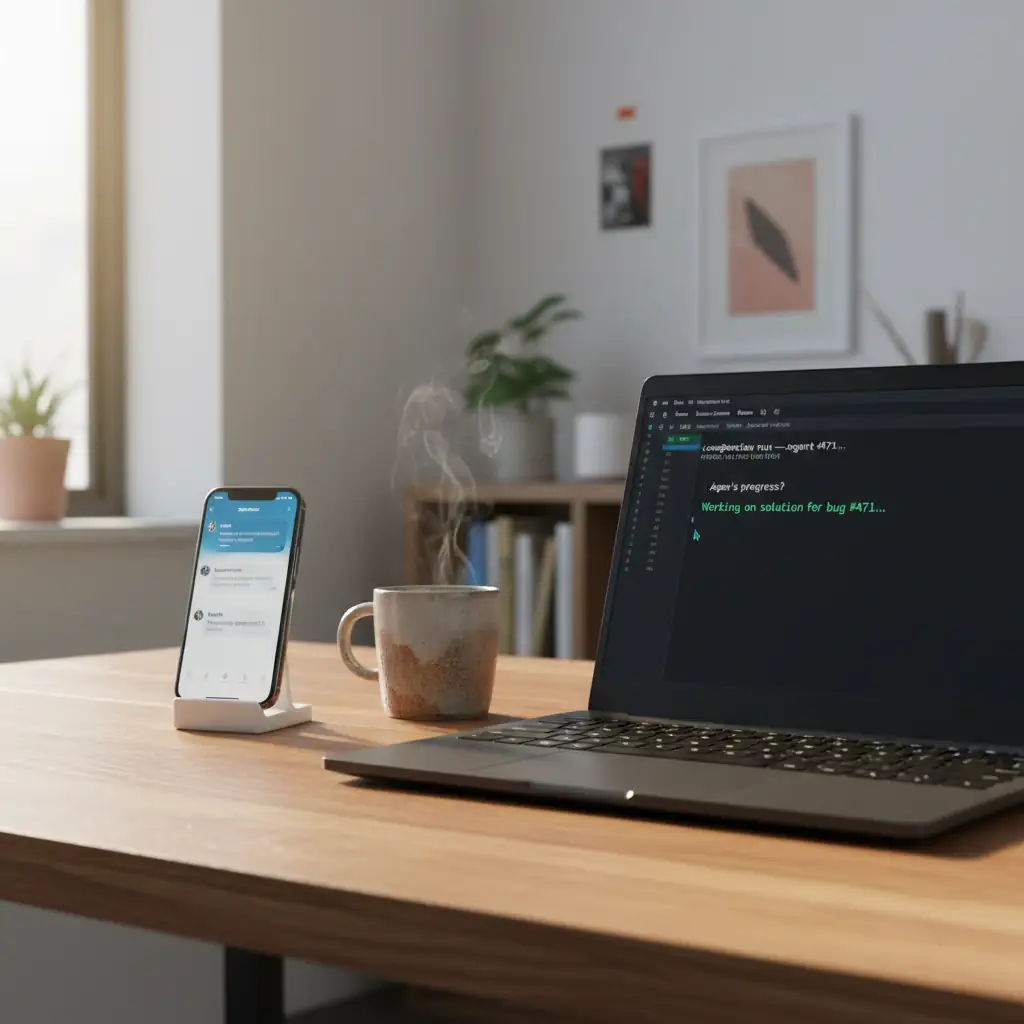
OpenClaw spent the first quarter of 2026 going from a curiosity to the most-starred self-hosted AI agent on GitHub. The personal-agent space it opened up is now full of capable alternatives, each making a different trade between control, safety, community size, and setup time. This guide walks through OpenClaw and seven serious rivals worth a look before you commit your morning briefings, inbox triage, and shell access to any one of them.
Why the agent market split open this year
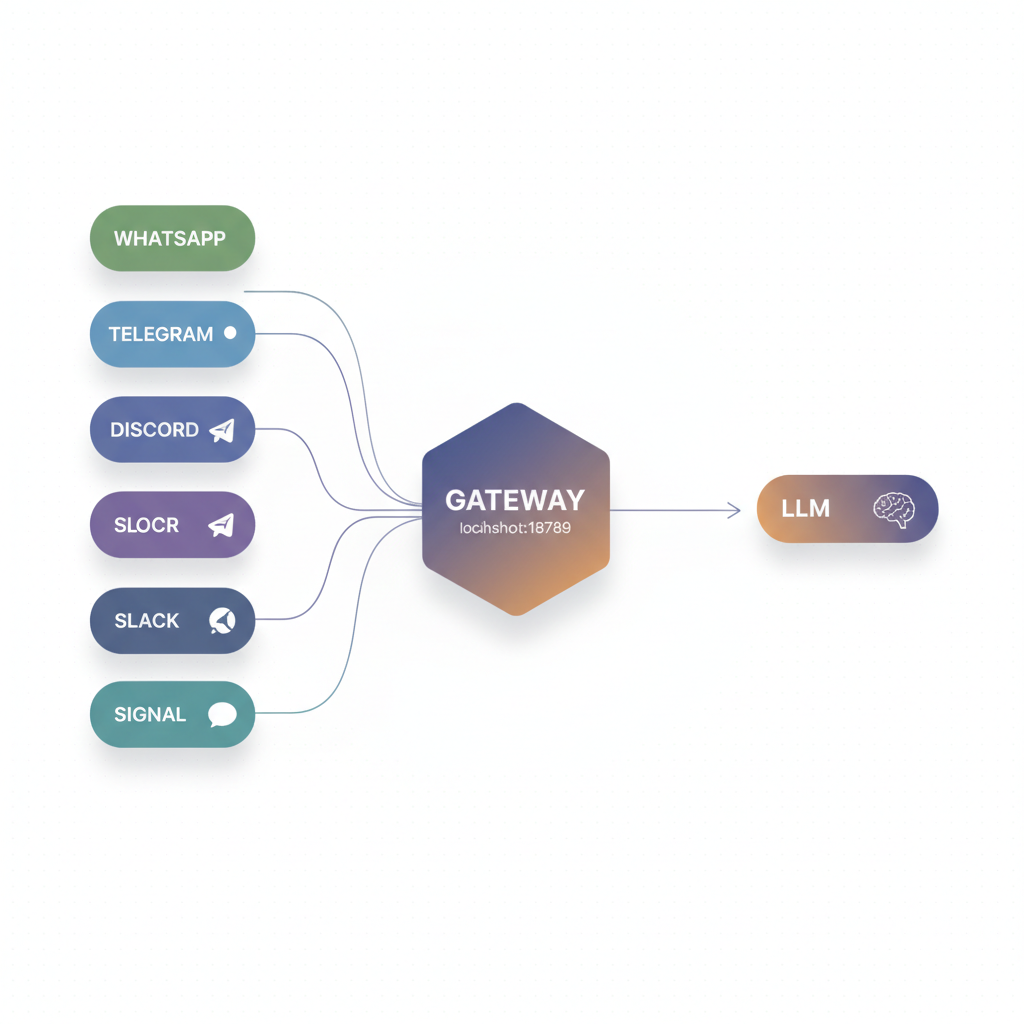
Personal AI agents stopped being a research demo somewhere around February. OpenClaw cleared a hundred thousand GitHub stars in days, Nous Research dropped Hermes Agent the same month and crossed 95,000 stars within seven weeks, and by spring the listing sites had begun publishing dedicated alternatives guides. The pull is the same in every case: a single process on your machine or VPS that connects WhatsApp, Telegram, Slack, and Discord to an LLM with permission to actually do things. The split happens after that. Some teams want maximum platform support and accept the security trade. Others want hardened isolation, a lighter footprint, learning memory, or a managed service that someone else patches at 3am.
1. OpenClaw — the incumbent that started the wave
OpenClaw is the agent that turned this space from a research topic into a category. The framework began life as Moltbot, briefly became Clawdbot before an Anthropic cease-and-desist over the name's similarity to Claude, and settled on its current name in early 2026. Peter Steinberger, the PSPDFKit founder behind it, designed the gateway as a single Node.js process bound to localhost on port 18789. Messages from any connected channel route through that gateway to an LLM of your choice, with the model bringing its own tool calls back. Recent reports counted nine CVEs in a four-day stretch, all tied to community-submitted skills that the project accepts with light review.
- Skill library: over 13,000 community skills covering email triage, browser control, file management, and shell access.
- Channels: WhatsApp, Telegram, Discord, Slack, Signal, and several smaller bridges.
- Model support: Claude, GPT, Gemini, and local models through Ollama. Bring your own key.
- Pricing: framework is free under MIT. You pay for LLM tokens.
- Best for: solo builders who want the widest reach and accept that broad community skills come with broader attack surface.
2. Hermes Agent — the self-improver
Hermes Agent shipped on February 25, 2026 and crossed 95,000 GitHub stars within seven weeks, the fastest growth of any agent framework this year. Nous Research, the lab behind the Hermes, Nomos, and Psyche model families, built it around a single design choice that the rest of the field has not matched: a closed learning loop. When the agent completes a task with five or more tool calls, it writes a Markdown skill file describing how it got there. Next time something similar comes in, the skill loads instead of fresh reasoning. Internal benchmarks show that after twenty self-created skills, research tasks finish 40 percent faster.
- Memory: agent-curated cross-session recall with FTS5 search and Honcho-style user modeling.
- Channels: 20+ platforms including Telegram, Discord, Slack, WhatsApp, Signal, Matrix, Email, SMS, and DingTalk.
- Hosting: six terminal backends including Daytona and Modal, which hibernate when idle.
- Pricing: free under MIT. The managed FlyHermes option starts at $29.50 for the first month then $59 per month.
- Best for: daily users who want capability that compounds over months, and teams worried about OpenClaw's CVE history.
3. Manus — the autonomous cloud agent now inside Meta
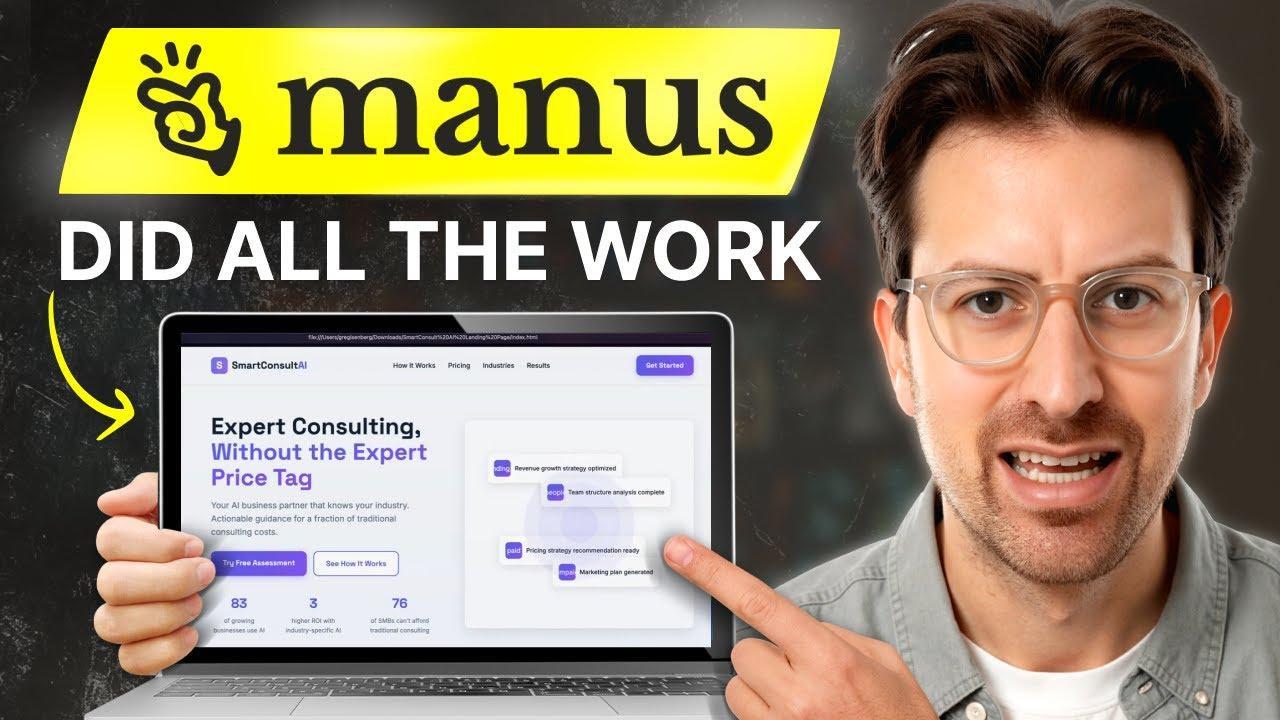
Manus took a different bet on the same problem. Where OpenClaw and Hermes hand you a Node or Python process to run on your own machine, Manus runs entirely in the cloud and delivers finished work back. Built by Butterfly Effect and launched in March 2025, the product hit two million people on the waitlist and reached $100 million in ARR within eight months. Meta announced its acquisition of Manus for over $2 billion in late December 2025. The agent uses an orchestrator-led architecture with a central Planner that decomposes complex requests into roughly 50 tool calls per task. It runs on Anthropic Claude and Alibaba Qwen rather than a proprietary model. A note on regulatory status: on April 27, 2026, China's National Development and Reform Commission ordered the parties to withdraw the acquisition, which leaves Manus's ownership structure unsettled at the time of writing.
- Execution model: cloud only, no self-host option.
- Pricing: Standard plan at $20 per month includes 4,000 credits. Complex tasks consume 500 to 900 credits each, which effectively caps you at four or five autonomous research jobs per month.
- Strength: genuinely async, multi-step research with polished output.
- Risk: regulatory uncertainty post-NDRC ruling, cross-border data flow, and no transparency on credit consumption before a task runs.
- Best for: knowledge workers who delegate three to five complex research tasks per month and do not handle customer PII.
4. Claude Computer Use — the Anthropic answer
Claude Computer Use is Anthropic's take on the same problem with a different interaction model. Rather than reading the accessibility tree, the agent works from screenshots and visual reasoning, deciding where to click by looking. The flexibility of that approach is real, since it can interact with any pixel-rendered interface, but the latency and click-precision cost is also real. Reviewers report occasional misclicks on form dropdowns that need manual correction. The self-hosted version ships as a Docker container, which gives it OS-level isolation that OpenClaw lacks. The hosted version is available through Anthropic's Claude Max plan.
- Architecture: screenshot-based visual reasoning loop.
- Isolation: Docker container with a defined permission scope.
- Model lock-in: Anthropic Claude only.
- Pricing: free self-hosted with your own API key, or paid through Claude Max for the managed version.
- Best for: teams already inside the Anthropic stack that want sandboxed control over a visual workflow.
5. ZeroClaw — the Rust rewrite
ZeroClaw is what you get when someone reads the OpenClaw source and decides to redo it in Rust. The result is a smaller binary, no Node toolchain to install, and a runtime that ports more cleanly across operating systems. The feature set is narrower than OpenClaw's, but for users who care about resource use or want to avoid pulling Node onto a slim VPS, the trade can be worth it.
- Language: Rust runtime, no Node dependency.
- Footprint: lighter resource use than OpenClaw, runs anywhere Rust compiles.
- Skill coverage: smaller catalog than the original.
- Pricing: free, open source.
- Best for: developers who want OpenClaw's basic shape with a lighter runtime.
6. PicoClaw — the minimal-footprint option
PicoClaw goes further in the same direction. The build uses what its authors call a self-bootstrapping process to produce an agent that fits under 10MB of RAM and starts up in roughly one second. It supports 16 or more chat channels and runs on hardware as cheap as a $10 single-board computer. As a tradeoff, advanced features and the larger community skill library are not there.
- Footprint: under 10MB RAM, one-second boot.
- Hardware target: budget single-board computers and slim VPS plans.
- Channels: 16 or more messaging platforms.
- Pricing: free.
- Best for: hobbyists running personal agents on a Raspberry Pi or a $2 VPS plan.
7. NanoClaw — the container-isolated pick
NanoClaw treats container isolation as a primary design constraint rather than an option. The agent ships as a single binary under 50MB, runs inside a container by default, and costs around $3.50 a month to host on a small provider. The honest caveat is that containers reduce blast radius but do not by themselves solve the security questions that come with broad host access. NanoClaw helps with the first half of that problem and leaves the rest to the operator.
- Binary: under 50MB, single file.
- Isolation: container-based by default.
- Hosting: around $3.50 a month on a small provider.
- Pricing: framework free, hosting variable.
- Best for: small teams who want a defined attack surface without the overhead of a full enterprise hardening project.
8. IronClaw — the enterprise zero-trust option
IronClaw is the choice for regulated industries that cannot deploy OpenClaw's permission model in good conscience. The project trades community skill size for zero-trust architecture, audit logging, and the kind of compliance-friendly defaults that survive a security review. The skill catalog is smaller and the setup is heavier, but for healthcare, finance, and legal teams that need an agent at all, IronClaw is roughly the only viable self-hosted option in this list.
- Security model: zero-trust architecture with audit logging.
- Skill catalog: smaller than OpenClaw, curated rather than open.
- Setup: more involved than the consumer-grade tools.
- Pricing: framework free with a paid enterprise support tier.
- Best for: regulated industries that need an audit trail and a defensible security posture.
How to put it all together
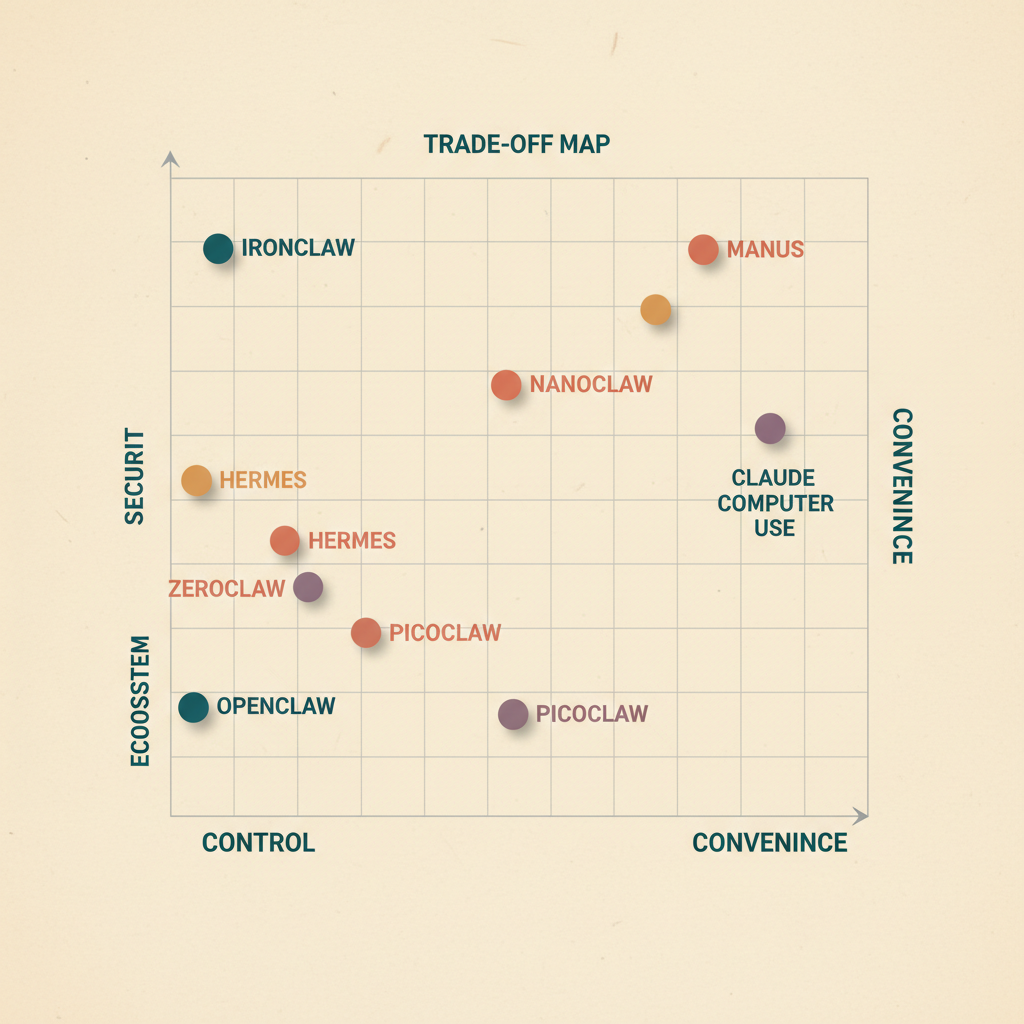
Choosing between these eight is less about features and more about the trade you can live with. If broad community support and the largest skill library matter most, OpenClaw is still the obvious starting point. If you plan to run the same agent every day for six months or more, Hermes Agent compounds in ways a flat-architecture tool cannot. For teams in regulated industries, IronClaw is the only choice that survives a compliance review. Managed cloud options like Manus or Claude Computer Use make sense when you want a working agent in an hour and are comfortable with the privacy and credit-consumption trade.
A reasonable migration path is to start with OpenClaw, learn what the agent actually does for you, and switch later if a different design suits your usage. Hermes ships a built-in OpenClaw migration command that imports settings, memories, skills, and API keys with a dry-run preview, which keeps the cost of changing your mind low. ZeroClaw and PicoClaw are easier to evaluate as parallel installs rather than full migrations.
Closing thoughts
The self-hosted agent space is not going to settle in 2026. New entrants will keep arriving, the security stories will get worse before they get better, and a few of the names in this list will look very different by Q4. Pick the one that fits your current risk model, plan to revisit the choice in six months, and keep your skills portable so the switch stays cheap. For more agent-side tools to pair with whichever framework you choose, browse the AI agents category on AIToolsBox.